Showing posts with label Cruise. Show all posts

Wednesday, August 13, 2014

The Great Egg Drop Contest - Stories from the cruise

Many of the Princess cruise ships have a multistory open area they call the Piazza. It's a mall-like area with boutiques and cafes, and a stage for entertainment on the lowest level. One lunch we stopped at the International Cafe located in the Piazza, and the only open table was located very near this entertainment area, and that's how we became accidental participants in the Great Egg Drop Contest. Well, Barb did.

The contest features teams who had signed up to construct devices that hopefully cushioned a raw egg dropped from three stories up onto a hard (plastic sheet covered) floor. All the devices were cobbled together with whatever the contestants could find on board, or brought with them; a lot of shopping bags, tissue and toilet paper, and wearing apparel, such as socks, tennis shoes and even panty hose. 

The most inventive package (and the most disastrous) was a container filled with peanut butter as the cushioning agent. It burst open upon impact and peanut butter went everywhere! So did the egg. Some had parachutes to slow the descent, and that's where Barb's participation came in.
The parachute for one entry actually worked, but it drifted away from the bulls eye...and landed on Barb! The egg was safe, but the entry was disqualified because it didn't land in the target zone. The guy providing all the patter, and checking the eggs, asked Barb if she wanted to keep the egg, since she was already "intimately familiar with it." She declined.

Wednesday, August 6, 2014

Alaska - Victoria, B.C. - Stories from the cruise

The only Canadian stop on the cruise, Victoria, capital of British Columbia, is a delightful city. Located on the southern tip of Vancouver Island, it is equidistant (about 60 miles) from both Vancouver and Seattle. First settled by the British in 1843, it trails Seattle by 11 years for being the oldest city on the Pacific Northwest. Never mind that the Coastal Salish First Nations people lived here for centuries before James Douglas, on behalf of the Hudson's Bay Trading Company, set foot on the Island.


Victoria is a beautiful little city. Its history is reflected in the beautifully restored buildings, and the temperate weather promotes year-round botanical marvels. Our tour guide said that Victoria is a favored place to retire, but no place is perfect. The same earthquake fault that threatens California is present here; but the guide said that when the big one comes, Victoria will end up parked on top of Vancouver.

The driver pointed out a statue of George Vancouver, who was responsible for the discovery and development of the region. Originally cast in copper, the green patina made George appear continually sea-sick so the city fathers decided to recast the statue in gold. Unfortunately, when they removed the copper statue to use as a mold, they destroyed one of the legs. So they used the remaining leg as the mold for both and if you were able to look closely, you would see that George has two left feet.
I have been to Canada on several occasions, but not since Homeland Security and Customs and Emigration  and Border Paranoia became a big deal. My first visit, long ago, was on a tour bus at Niagara Falls. Having seen the US side, we crossed over for the Canadian view; a border guard stuck his head inside the bus and shouted, "Anybody not a US Citizen?" When he got no response, he stepped aside to let us pass.

Years later, with the border a bit more controlled, I made a trip to Toronto to speak at a conference. I got to the airport in Austin without thinking about what documentation I might need, and while it took a bit of fast talking on my part, the airline agent stamped my ticket "Documents OK" and away I went. I spent a week in Canada as an undocumented alien. During that time, I worried just a bit about the return trip, but for that leg of the trip I just walked out of Canada into "US territory" at the airport, got on the plane and came home.

The next time I went to Canada on business, I decided not to press my luck and took official documentation, though still not a passport.

To be sure, we had ventured onto Canadian soil earlier in the cruise when the train over White Pass continued into Canada for a few miles before reaching a turn-around junction in the track, so technically we were undocumented aliens at that point, since no one told us we needed passports to take the train trip.

They did tell us that we would need passports in Victoria; in fact, you couldn't board the boat in Seattle without a passport. You had to have a passport, even if you didn't get off the boat in Victoria. So, official, stamped, certified passports in hand, we disembarked, walked about a hundred yards into the Canadian Customs and Emigration building there at the docks.... and walked right on through without a single person giving us a glance!

Coming back, they did check... our cruise ID card, and that was it. Only when we got back to Seattle and left the boat to come home did anyone look at our passports. I wonder, if we had none at that point, would they have put us back on the boat, which was sailing again in just a few hours? Just a thought.

Wednesday, July 30, 2014

Alaska - Pretty little Ketchikan - Stories from the cruise

Ketchikan is the southernmost city in Alaska, 700 miles north of Seattle. Like all Alaskan coastal towns, it was originally a Native fishing village. Fishing is still a major industry and the town promotes itself as the "Salmon Capital of the World." And since the cruise ships stop here, tourism is the significant source of revenue from May to September.

The southern part of town serves the tourist trade, with rather high-end stores and shops right next to the new cruise ship docks. The more typical tourist schlock is available a few streets away on Creek Street; once a brothel district. It was said that both salmon and fishermen came to Ketchikan to spawn.


 Ketchikan is billed as the totem capital of Alaska, but most are located away from the downtown area in the Saxman Totem Park, Totem Bight State Park, Potlatch Park, and the Totem Heritage Center. I did find a few, located in and near a beautiful little park.
 This one was so tall, I had to take two pictures.
I thought the flowers in the park were more interesting than the totems, though.


Back on the ship, Barb and I sat and watched preparations for sailing. Departure time was 11:45 and at 12:20 there were still dawdlers wandering down the wharf. A final couple wandered up and the security guy got in their face and urged them repeatedly to hurry and board, so naturally, they stopped to take pictures! Evidently this couple told security that there were other passengers in a restaurant across the street, because two officers trotted over there to check, but returned empty-handed.

They got the gangways pulled away, and the gangway doors closed, and the ship was underway. It can move sideways, by the way. Then we saw one last couple wandering down the wharf. A Port of Ketchikan official who had been present for the departure met them, and you could see them looking at their watches and at the ship - the departing ship - and I'm pretty sure they were a bit excited at that point. We wondered what the airfare is from Ketchikan, Alaska to Victoria, British Columbia.

We were talking to a young Ukrainian girl, one of the waitstaff, and she said passengers get left on a regular basis (we found out later that 6 were left in Ketchikan). The ship waits for no one. She said sometimes crew members miss the departure; in that case they have to figure out how to survive until the following week, when the boat comes back. And then they have a lot of  'splaining to do.


Next port: Victoria, British Columbia

Wednesday, July 23, 2014

Alaska - Glacier Bay National Park - Stories from the cruise

On our journey, quite often the ship would slow its pace to allow pilots - experts in local navigation - to board or disembark. When we entered Glacier Bay National Park, we took on a group of Park Rangers and Naturalists, who stayed with us until we left the Park that evening, providing commentary and answering questions throughout our visit.
One of only a handful of National Parks accessible only by boat or seaplane, Glacier Bay has moved through a series of designations and expansions, beginning as a National Monument in 1925, and becoming a National Park in 1980, encompassing some 3,283,000 acres. It is also a National Preserve, a UNESCO World Heritage Site, and a Biosphere Reserve, as well as the home of a significant population of Hoonah and Tlingit Native Americans.

What can I say about Glacier Bay? Here's a quote from journalist Sherry Simpson, writing in a gorgeous book of photos by Mark Kelly:
"Every one of us who attempts to capture Glacier Bay fails and always will, because this is a place that cannot be preserved by words or photographs or statistics. Look away, and everything becomes new. The light shifts. The ice cascades. The tide ebbs. Glaciers carve up time and leave behind a stony blank space, and then life fills up the space slowly, slowly. This is the world on its way to becoming something else." 
About 4,000 years ago, the entire basin was a single glacier. Over the centuries, the ice has retreated and geologists now count 50 named glaciers within the park boundaries. From the limited view of the cruise ship, with less than a day to spend, we saw but a handful. The scope of the place is staggering, and the realization of just how much wilderness and habitat surrounds you is mind boggling. It truly cannot be preserved by words or pictures. So, I will share with you some trivial thoughts, some things that surprised me.

One is that some glaciers don't look like what we expect glaciers to look like. Some are barely distinguishable from bare ground.
This is the face of the Grand Pacific Glacier. It has scraped up so much rock and soil as it advanced, it resembles a rocky hillside. Interestingly, it is adjacent to the Margerie Glacier, pictured below.

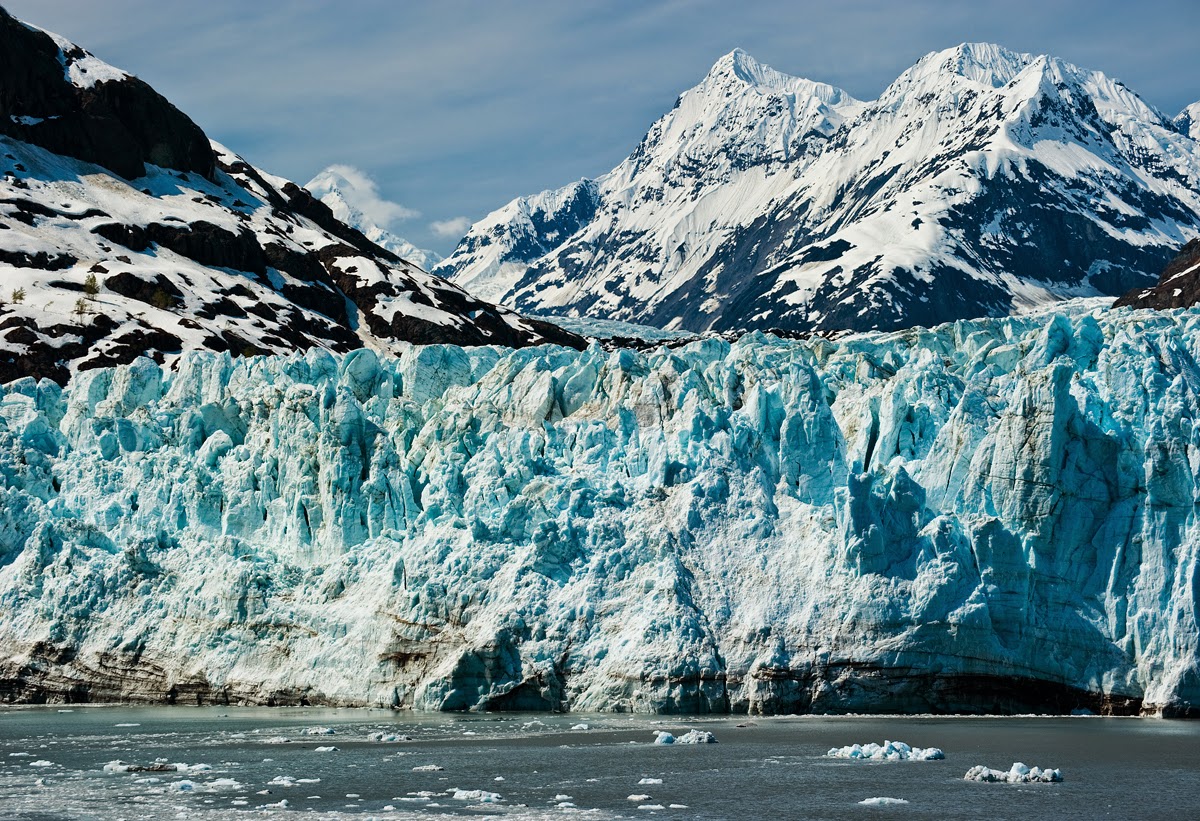
Another surprise; the turquoise-blue color of the "clean" glaciers. The density of the ice absorbs most of every other color of the spectrum except blue, leaving a distinctive coloration.
Still another surprise, is the noise they make, ranging from booming thunder to sharp cannon-fire.The glaciers are in constant motion, either receding or advancing. The Margerie Glacier is stable, maintaining its 21-mile length from year-to-year, but it still "flows" six feet a day!

And that's another thing. You look at the mass of ice visible above the water and you think that you are looking at many centuries of accumulation. In fact, the ice at the face of the Margerie Glacier was snowfall less than two hundred years ago.

And when glaciers retreat, the earth "rebounds" - rises in elevation measurably. Freed from the billions of tons of overburden, the crust of the earth slowly regains some of the depression that occurred. In Gustavus, just outside the Park, the land is rising almost three inches a year; the high tide line has pushed almost a mile out to sea in the last 50 years.

So much for glacier trivia. On to Ketchikan.

Wednesday, July 16, 2014

Alaska - Skagway, gateway to gold - Stories from the cruise

During the night, the Golden Princess slipped back down the Lynn Canal and headed north, navigating some 93 nautical miles up the Taiya Inlet to Skagway (just above the "12" marker on the map). We came here, among other reasons, to ride a train.
Skagway has a long history of visitors just passing through. For centuries a sleepy Tlingit Indian fishing village, the discovery of gold in the Klondike region of Canada's Yukon Territory in 1896 changed everything. On July 29, 1897, the steamer Queen docked with the first boat load of prospectors and soon other ships brought tens of thousands of hopeful miners into the new town to prepare for the 500-mile journey to the gold fields in Canada.

Not everyone headed to the gold fields however; many realized how difficult the trek ahead would be and chose to stay behind to supply goods and services to miners - known as "mining the miners." Within weeks, stores, saloons, and offices lined the muddy streets. By June 1898, with a "permanent" population nearing 10,000, approximately 1,000 prospective miners a week passed through town. Skagway became the largest city in Alaska at the time.

The most heavily-traveled routes by "stampeders" to the gold fields in Dawson City were two treacherous passages from the port of Skagway and nearby village of Dyea across the Boundary Ranges of the Coast Mountains to the Canadian border; one by way of the Chilkoot Pass and the other over the White Pass.

At the border, the Canadian North West Mounted Police would not allow prospectors to enter unless they had one ton of supplies. And not just any supplies - there was a very lengthy and very specific list that included, for instance, how much rope, how many blankets, how many picks and shovels and even how much soap to bring into the promised land! This usually required several trips across the passes. 
With an obvious need for better transportation than pack horses used over the White Pass or human portage over the Chilkoot Pass, the White Pass and Yukon Route narrow gauge railway - the WP&YR - was constructed as a means of reaching the gold fields. It was a prodigious engineering feat, costing $10 million 1890 dollars. At one point, 35,000 men were employed in its construction. It was completed in 1900, just as the gold fever was ending.
 Hauling freight and ore kept the line in business, in one form or another, until 1982, when it finally shut down. And then the cruise ships showed up in the Taiya Inlet. Today, the WP&YR is thriving as a "Heritage" rail line, carrying over 390,000 passengers during the 2012 May to September tourism season.
As you can see, that old wooden trestle is still in use, a fact that did not please a certain tourist on this excursion.

Today, diesel locomotives pull vintage parlor cars on the line ( a steam engine is available for charter). The most popular route is a 20-mile excursion up the Skagway River Valley to the White Pass, rising some 3,000 feet in the process. At times the grade is nearly 4%, and the hair-pin curves hug the twisting, turning route blasted out of solid rock, or cross the canon on narrow trestles..
 The gold and the miners are long gone, and the current population of Skagway is 920 hardy souls. The visitors, however, are still coming. More than 900,000 people visit Skagway each summer, coming, as we did, on the cruise ships that dock daily. Today's economy is based solely on "mining the tourists."

Next destination: Glacier Bay National Park.

Wednesday, July 9, 2014

Alaska; first stop Juneau - Stories from the cruise

When you look at a map of Alaska, you see an enormous land mass top center that accounts for most of the 586,412 square miles in the state. There's a long line of some 300 islands, the Aleutians, that extend 1,200 miles to the west, and a narrow band of coastline and coastal islands that descend southeastward, interposed between the Gulf of Alaska and the Pacific Ocean and the northern edge of British Columbia, Canada. This last area is known as the Inner Passage, and that's the Alaska we visited, as have many thousands of others.

Alaska was surprisingly warm for early June; here's the temperature from the daily shipboard update. Pretty humid, too.

In fact, the weather was wonderful for the most part. We did need jackets from time-to-time, especially when we were on the exposed areas of the deck in the wind, but often, we enjoyed shirt-sleeve temperatures and low humidity.

Our first port of call was Juneau, the state capital, and the only U.S. capital city with no automotive access.
 Every brick, every automobile, every tour bus, every manufactured item, every drop of gasoline comes to Juneau by way of airplane or boat (surprisingly, gasoline was only $4.15 a gallon). By area, it is the 2nd largest city in the US, almost as large as Rhode Island and Delaware combined, but with a population of fewer than 33,000 citizens. The eastern city limit is the Canadian border!

Our excursion from the cruise ship in Juneau was a combined visit to the Mendenhall Glacier and later whale watching. The glacier is a scant 12 miles from downtown, and certain versions of the tour allow you to set foot on the glacier. Our tour was limited to a view from the visitor center, and the exhibits of the center itself.
Unfortunately, our first excursion was almost our last. The ship was two hours late docking in Juneau, due to rough seas (I mentioned that in an earlier post), and the excursion schedules were a mess. Word from the bridge was that we would be informed about the new schedule, but after docking, no word came. We finally set out to find out for ourselves and learned that we should go ashore and find our tour. Let's just say that this was not Princess Cruise Lines finest moment (the revised schedules were waiting for us when we returned). We did finally find our tour and set off by bus to the glacier.

By this time, it was raining steadily, one of only two occasions the entire trip. Our bus driver dropped us off at the visitor center and told us she would pick us up at that same spot in an hour. This was significantly shorter than the time set out in the tour description, but when we realized that about 10 times the number of people you could comfortably fit in the visitor's center were in fact, already in the center, time became unimportant.

So, in the rain, after viewing the glacier, and a brief visit to the center, we trudged back to our drop-off point to re-board the bus, only to run afoul of bureaucracy at its best. A park ranger vehemently denied us access to the pick-up point, pointing instead at the front of the queue of 20 or so tour buses, insisting - nay, demanding - that we should not pass. From our distant viewpoint, we could not see our bus number, but time was passing. Finally, our driver came and found us and we boarded the bus in shame, as the other 48 passengers had had obviously been un-cowed by the park ranger traffic-Nazi, and had been waiting patiently for us.

On to whale watching. The company that fulfills the whale-watching excursion prominently touts that they will hand you $100 cash when you disembark if no whales are seen during the 3-hour trip. They have never paid off. During the summers, thousands of Humpbacks and Orcas return to the waters of Alaska to feed and fatten up for their long migration to warmer climates like Hawaii.and Mexico for breeding. Biologists count a consistent population of about 65 whales in Auke Bay, where we were.
We encountered our first Humpback within minutes, and saw probably half-a-dozen during the cruise. They were "lunge feeding." leaping partially out of the water to scoop up the krill and sea-life that they feed on. Unfortunately, seeing and photographing are two different things. The rain had stopped by this time and we were back in shirtsleeves, checking out Humpbacks, Steller Sea Lions, and an extended observation of a pair of bald eagles feeding. And we had no problems with the bus ride back to the ship.

Next port: Skagway.

Wednesday, July 2, 2014

A very big ship - Part II - Stories from the cruise

A cruise chip is actually a large, floating, resort hotel with all the amenities; 1,500 or so guest rooms, multiple restaurants (5 on this ship), art galleries (2), spas (9 of them), swimming pools (4 plus hot tubs), a front desk (where you can go - repeatedly - when your key card quits working), casinos, theaters, bistros, night clubs, video arcades, a gym, a golf course (!), a wedding chapel, numerous bars, a pizzeria, a BBQ grill, a Sundae shop, a library, an Internet Cafe, room service, and a picture puzzle table.
There are also large kitchens on the ship, churning out food 24 hours a day. Barb and I opted for the less formal buffet for our meals. They handed you huge plates and bid you Bon Appetite as you tried a little of this and a little of that, and ohh - that looks good. Pretty soon you needed help carrying your plate! And of course, you could always go back for more.

And you could come back later in the morning/afternoon/evening for cookies/desserts/sundaes.Or you could just order from room service and it would magically show up at your door. We did not, however, find any Tex-Mex on board. No chips and queso.

Waitstaff was omnipresent, bringing drinks, whisking away empty plates, and constantly replenishing your coffee or coke. For every few servers there appeared to be a manager, and for every few managers there appeared to be a supervisor.

The crew members were largely multinational; we met several from Peru, one from the Ukraine, many were Filipinos. The Captain was a Scot, the First Officer was Italian, and we never did place the accent of the person who made the public announcements (or understand him, either).

Each meal began with an obligatory Purell hand sanitizing; they wouldn't let you in the buffet line without one; Princess must buy the stuff in fifty-five gallon barrels - there were dispensers everywhere you turned. Of course, there's good reason for this; cruise ships are floating petri dishes and a boat load of norovirus-stricken passengers is everyone's worst nightmare. I think on average, we washed our hands forty times a day!

Leaving the ship, there was always a photo opportunity, with crew members dressed in costumes representative of the area (bear, moose, lumberjack, etc.) Security scanned your card and large signs informed you when to be back on board. That didn't always work out - we watched a tardy couple get left behind in Ketchikan. Later we learned six passengers missed the ship in that port.

When you returned to the ship, you went through security again, including an ID check and a pass through the metal detector. Some failed that part, and we saw the security staff confiscate some purchased items. For the most part, these seemed to be Ulu knives (I had to look it up) which were considered weapons, so security held them for you until your final disembarkation.

Some resort hotels have ocean views - on one side of the hotel. A cruise ship has ocean views on all sides, and the view is continually changing.

Wednesday, June 25, 2014

A very big ship - Stories from the cruise

 The size of modern-day cruise ships is staggering. Standing on the dock, looking up at these behemoths leaves one speechless. We sailed the Inner Passage on the Golden Princess, a modest-sized vessel of 109,000 gross tons that carries 2,600 passengers plus 1,100 crew members. I say modest because there are 48 active ships larger than the Golden Princess. The largest ships are the Royal Caribbean Allure of the Seas, and her sister ship, Oasis of the Seas, weighing in at 225,282 gross tons. Each carries 6,296 passengers and crew!

The Golden Princess is 951 feet long, beam of 159 feet. From waterline, this boat is 18 stories (decks) tall, with 4 floors in the "basement." One would think that this massive superstructure would result in a significant draft below the waterline. I was surprised to find it was only 29 feet. The aircraft carrier USS Lexington, by comparison, is only 833 feet long and weighs 36,380 tons

Embarking on a cruise is much like embarking on a plane trip; arrive at a jam-packed terminal building, check your luggage, present your documents (one of which swears that you are not at the present time, nor have you recently been ill), proceed through security on your way to the boarding gate. About the only difference is that you are photographed and your photo is tied to your key card (door key, ID and on-board charge card)..

We opted for a room with a private balcony, but privacy is a relative term. If you sneeze, neighbors from two rooms on either side of you and from above and below you say, "Bless You." And from our vantage point on the 12th deck, we could look over the rail and see into about 100 other balconies.We had a group of Japanese on one side of us, and two couples of Mid-Westerners on the other.  Not sure about their sleeping arrangements; those rooms were the same size as ours. Maybe they just had a lot of friends visiting.All of the time.

We sailed from Seattle on a beautiful afternoon, and enjoyed being "top side" for a long time. Finally returned to our room to find all our luggage had been faithfully delivered and met our wonderful room steward Mac. Got unpacked, went to the buffet for a meal and settled in for the evening.

During the night, the winds picked up, we moved out into the open waters of the Pacific, and the ship began a little rocking and rolling. It felt like being in an airplane in a really bumpy stretch, and you kept expecting the captain to turn on the seat belt sign. If we had been wearing those new motion sensing bracelets, we would have racked up the miles while seated!

Lying in bed, it felt like someone had their foot on the bed, jostling it repeatedly - a feeling similar to an earthquake we experienced in Mexico City once. From time to time, it felt like the ship was going over a speed bump!

The next morning was even worse. For folks that already stagger a bit, making our way to breakfast was an adventure. There are rails almost everywhere, thankfully, so we clung tightly and pulled ourselves along.

On deck, all the water in the swimming pools was sloshing over their sides. In the inner part of the ship, the creaking and groaning of the walls and bulkheads sounded like the soundtrack of a movie about wooden sailing ships on the high seas. We met a lot of green-faced individuals along the way.

 We had motion sickness medicine with us, both the Scopolamine patches and the meclazine tablets, but neither of us felt sea-sick, and I'm pretty sure we can say after that day's sailing we never will be. The TV said we were experiencing "mild" seas, winds at 33 knots (38 mph). Later the Captain talked about the 50 knot winds (58 mph) that delayed our arrival into Juneau. We heard a crew member say "that was the worst he had ever experienced!" Here's a little video from that experience:
Fortunately, by evening, things were much calmer, and from that point we had nothing but calm seas.

Next: living the good life, in Part II

Wednesday, June 18, 2014

Planes, trains, automobiles - and a very big ship

I am a homebody. The comforts of my recliner, my bed, my books, my TV, my routines, overwhelmingly call to me. But even recluses have families, and bucket lists.

So over the past several weeks, Barb and I went traveling. First to California, to celebrate our oldest grandson's graduation from high school. Strange. I'm sure that it was only last Tuesday that his father called from Prague to tell us that we were grandparents.

And since we were so close, it seemed this was the time to check Alaskan Cruise off the list. Juneau, Skagway, Glacier Bay, Ketchikan, Victoria B.C, and Seattle. Check, check, and check.
Close is a relative term. We traveled 4,389 miles on airplanes, 2,328 miles on a very big boat, 269 miles in rental cars, 261 miles on tour buses, 44 miles on a train, 31 miles on airport shuttles, 15 miles in a taxi, and an unknown distance in a smallish boat watching whales feed in Auke Bay. That's a total of more than 7,337 miles. We called this the "broken butt" tour.

The Alaskan Cruise is big business. At each port of call there were three and sometimes four giant cruise ships docked, each capable of carrying about 3,000 passengers. From port to port we seldom cruised alone; there was usually a companion ship just behind, or just ahead, or on one day right alongside. It was a Dutch ship and all day it felt like we were racing - at 20 knots. Go, team! USA! USA! Our ship left Seattle at 4pm on a Saturday and returned at 7am the next Saturday. At 4pm that same day, it set out on the same cruise again, and will do so all summer long.
When we would dock, scores of tour buses would line up on the wharf areas to gather up passengers for the various excursions. In Skagway, the train rails came down to the docks, alongside the boats. In Ketchikan, the restaurants, shops and tourist attractions were built dock-side. Every day boats arrive and 10,000 or more passengers troop off to spend their money and then they troop back on - for the most part - and then we would slip away to the next port, making room for tomorrow's boats. But the tourist season in Alaska, like the growing season, is short and there were tip jars in the vans and buses that read, "Because Winter is coming."

It was interesting to see the towns we stopped at. It was interesting to ride the train up over the pass that so many would-be-miners crested on the way to the Yukon gold fields at the turn of the century.
 It was interesting to venture into Canada for a few miles (my second time to visit Canada without documentation). I enjoyed the parks and flowers of pretty little Ketchikan, which is not entirely dependent on tourists.
 We found Victoria to be a lovely little town. Were it not the capitol of British Columbia you would think time had passed it by, preserving in its passage beautiful old buildings and idyllic parks.
 But I loved Glacier Bay. Snow-capped Mt Fairweather in the background, the massive, noisy, walls of convoluted ice were almost too big to comprehend. Two hundred feet of centuries-old blue ice showing above the water; another hundred feet below and stretching a half-mile wide, the glacier spoke loudly of its daily six feet of movement with cracks like thunder and  booming like cannon fire. We saw a small piece crack off and fall into the sea. Just a little piece. About the size of a house.

But my very most favorite thing of all was sitting on our balcony, cup of coffee in hand, watching Alaska drift by at a placid 20 knots on a calm ocean.